


Here's a scenario we see often: a company invests in a digital engagement platform like Pendo, builds a library of in-app guides, and deploys them broadly across the user base. Three months later, their customers are frustrated by unsolicited messages, muddying the carefully orchestrated experience. And at the same time, adoption rates in key customer segments are below benchmark, with existing engagement strategies proving ineffective.
The problem isn't the content itself, but rather the lack of segment-specific content governance.
Welcome to Beyond The Click by Balboa Solutions. In this issue we're reviewing our RACI matrix for managing in-app content (download it here🔗) through the lens of segmentation, including:
- White-glove accounts need specific consideration 🛡️
- SMB segments need scalability 📈
- Governance makes the difference ⚖️
- How to integrate segments with governance 🔗
📆 See you at Pendomonium in 2026? It's back in Raleigh from March 24-26 (link) and the whole Balboa team will be there. If you have deeper questions about this article or any other topics we've covered, we'd love to chat. See you there!
Let's dive in.
White-glove accounts need specific consideration 🛡️
In high-touch segments, the GTM team has carefully orchestrated every aspect of the customer experience. These are your most valuable accounts, often generating millions in annual revenue. Unsolicited in-app content feels off-brand in these relationships, and they actively conflict with the white-glove service model.
The solution is straightforward but often overlooked: exclude these accounts from automated in-app campaigns entirely. Tools like Pendo include account-level settings that prevent guides from showing to specific customers. Many teams don't even know this feature exists.
Why this matters:
- Maintains the premium experience high-value accounts expect
- Gives revenue owners confidence to support the in-app content program
- Respects distinct engagement strategies across your customer base
SMB segments need scalability 📈
At the other end of the spectrum, your down-market SMB segment operates on an entirely different model. The economics don't support high-touch engagement, so the business model depends on digital-first communication with minimal human interaction.
Here, in-app content isn't supplementary. It's the primary channel for driving adoption, mitigating churn, and scaling customer success.
But you can't simply blast the same generic message to millions of users and expect it to resonate. The segmentation needs to go deeper:
- By role and persona
- By product area and feature set
- By maturity stage in the customer journey
- By behavior patterns and engagement signals
This is where lifecycle marketing teams become essential. They understand the nuances of customer segments and can craft messaging that actually drives engagement.
Governance makes the difference ⚖️
Without clear ownership and defined processes around segment strategy, your in-app content program will struggle. The governance model needs to answer three "whos":
Who decides which accounts get excluded? GTM teams who manage customer relationships and need authority over the engagement strategy for their accounts.
Who determines segment-specific messaging? Lifecycle marketing teams who understand personas, pain points, and customer journey stages.
Who ensures technical implementation? Product teams who control placement, throttling, and publishing.
When everyone understands their role in managing segment-specific content, you avoid both extremes: alienating high-value accounts with irrelevant messages and underserving scaled segments with generic content.
Understanding team roles is exactly why we built our RACI matrix for managing an enterprise in-app content program. 👇
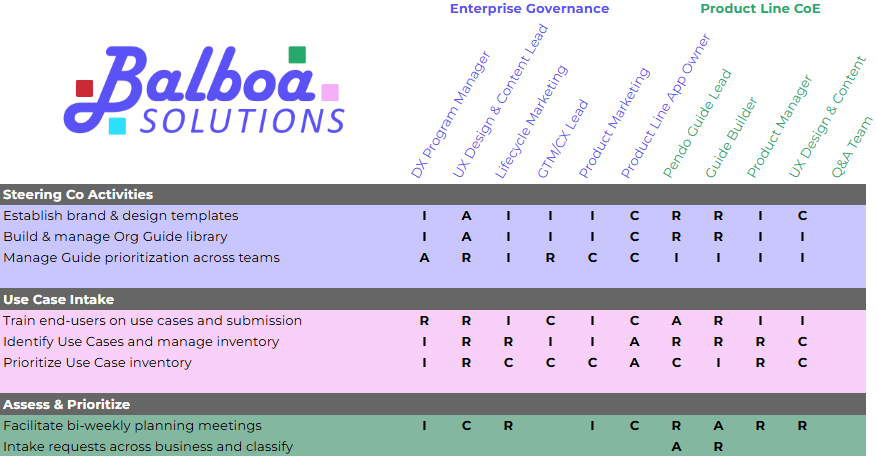 Link: In-App Content Governance RACI 🔗
If you're building or refining your digital content program, segment strategy needs to be more than an afterthought. Start by mapping your customer segments to engagement models:
- Identify which accounts need exclusions
- Determine which segments need intensive digital engagement
- Establish clear ownership for managing these distinctions
- Document the process so teams don't operate in silos
Our In-App Content Governance RACI matrix addresses exactly this challenge. It allocates responsibilities across 26 process steps, with specific attention to how different teams collaborate on segment strategy. Download it, adapt it to your organization, and start building the governance framework that turns segment strategy from a source of conflict into a competitive advantage.
Did a friend forward you this article? Subscribe to Beyond The Click and get the latest on Pendo and Product Ops straight to your inbox every other Thursday.⚡