

There are at least two things most companies have in common:
- Product owns the product
- Go-to-market (GTM) owns the customer
Tension shows up when you begin using the product as a channel to reach the customer. Digital experience platforms like Pendo collapse the boundaries between product and GTM teams, pulling product, CX, marketing, and data analytics into close coordination. That creates real opportunity and real conflict, especially in large enterprises.
Welcome to Beyond The Click by Balboa Solutions. Today we break down why enterprise DX governance is essential for long-term success with Pendo. We’ll cover 1.) why the CoE is only a starting point, 2.) how governance reaches beyond Pendo, 3.) why collaboration must run both directions, and 4.) how to use steering and intake to operationalize the model.
👉 A quick note: we’re hosting a virtual roundtable on this topic on 11/20 at noon ET. If you want to hear how peers approach DX governance, you can join us live. Register here for an invite.
Let's dive in.
The CoE is only the beginning ▶️
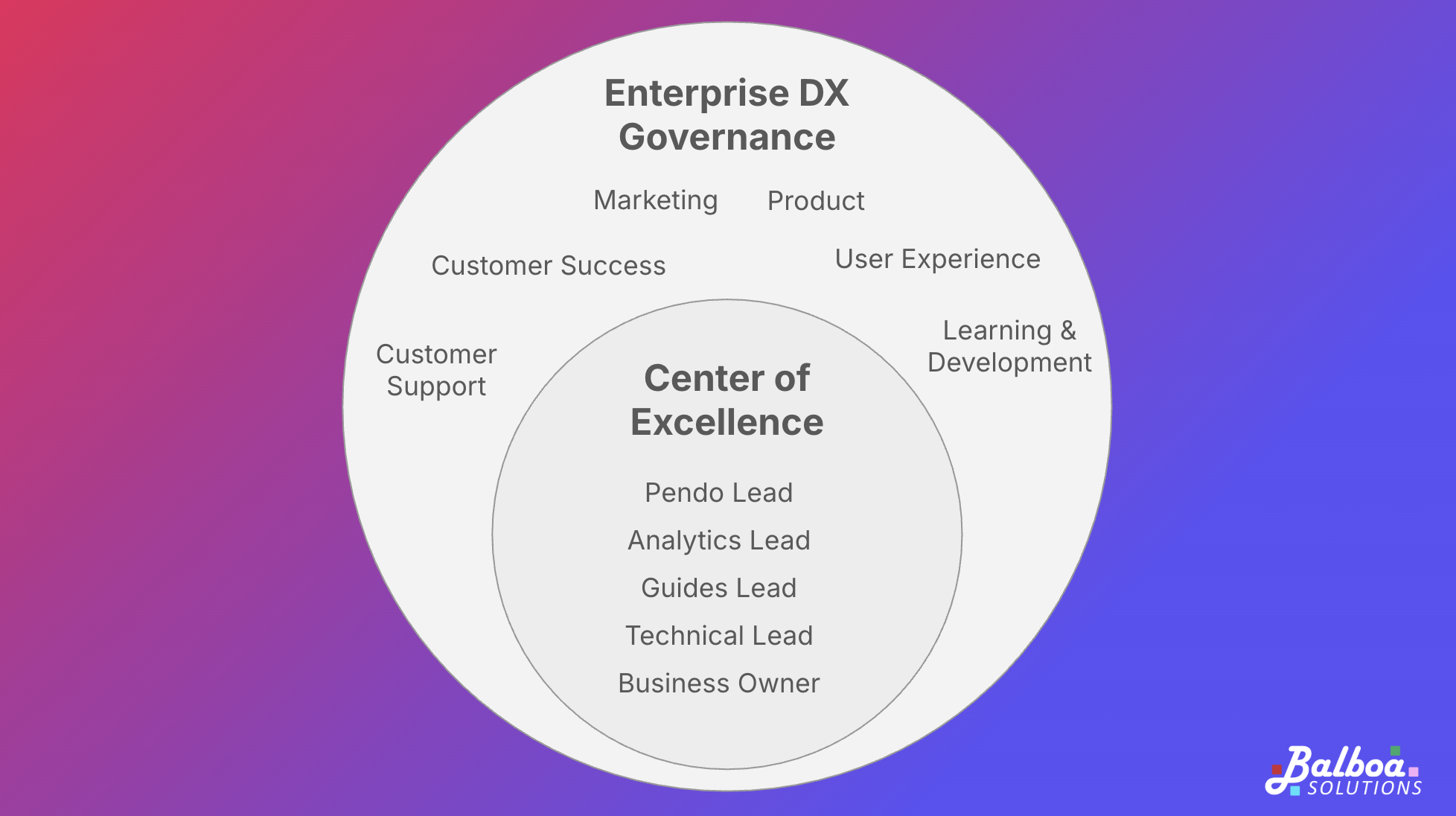
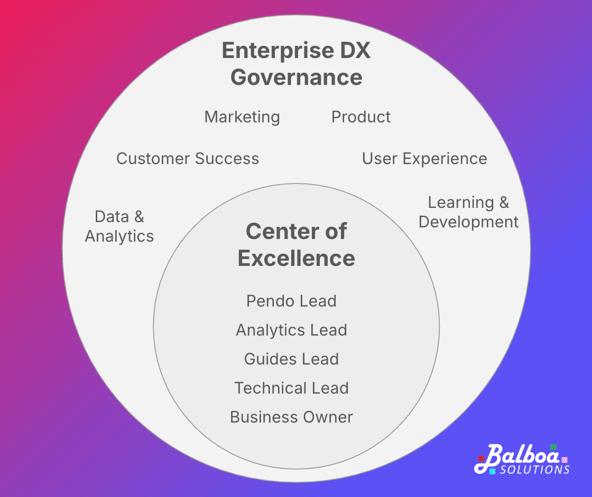
Most teams begin their Pendo journey by standing up a Center of Excellence (CoE). The CoE handles the hands-on work of installation, tagging, guide design, analytics, and day-to-day prioritization of use cases to deploy in Pendo. They spend a lot of time in Pendo and keep it running.
But as your Pendo program matures, the CoE isn’t enough to drive the full impact of Pendo within your organization. Once Pendo is integrated into onboarding flows, customer marketing programs, learning and development programs, support workflows, BI models, and revenue operations, the work of governing digital experience strategies extends well beyond the CoE. The teams who own the end-customer experience and associated revenue goals need a formal role in the Pendo program, even if they never log into the platform.
While the CoE owns application-level execution, the Enterprise Governance Model ensures that your DX program scales across the organization without confusion or conflict.
Governance goes beyond Pendo ⚖️
Enterprise DX governance recognizes that many departments influence customer experience in ways that intersect with Pendo. For example:- Customer Marketing teams ensure in-app communication aligns with brand voice and messaging strategy.
- Learning & Development adapts long-form training content for in-app delivery.
- Data & Analytics teams integrate Pendo telemetry into dashboards, models, and retention scores.
- Customer Experience ensures in-app programs support retention and growth priorities.
These teams don’t need to become Pendo practitioners, but their work shapes how the company leverages Pendo. They need structured involvement to ensure a cohesive customer experience across channels.
 Governance is a two-way street 🛣️
The best companies treat the relationship between the Pendo CoE and its cross-functional partners as reciprocal.
The CoE provides clarity on what’s possible with Pendo: real-time telemetry, in-app engagement, segmentation, and analytics.
Simultaneously, the departments provide clarity on what they need to support business initiatives, including audience goals, messaging, timing, and success metrics. Departmental users don’t need to be hands-on Pendo users, but they should know how to effectively request support from the Pendo CoE as needs arise.
Key governance processes: steering and intake 📥
Two processes turn governance from theory into practice:
- A steering committee
- An intake & triage process
The DX steering committee meets monthly or quarterly to align strategic priorities, resolve conflicts, and make decisions on how and where the DX platform is used across the business. This group sets direction, aligns teams, and makes enterprise-level decisions.
For example, take an enterprise with multiple, competing in-app communication resource center tools. Should they keep both or collapse them into one (e.g. the Pendo Resource Center)? The DX Steering Committee is responsible for gathering the necessary information and people to make a decision.
At a more tactical level, the CoE may deploy an intake process which gives the CoE a controlled, predictable way to receive requirements from various lines of business. Stakeholders submit requests tied to specific goals. The CoE evaluates, prioritizes, and executes on those requests.
This keeps cross-functional work coordinated, prevents ad-hoc requests, and makes Pendo scalable across many teams.
Building a foundation for scale 🛠️
When product and GTM teams operate in silos, digital experience stalls and may even become detrimental to the customer experience.
Enterprise DX governance closes that gap. Using a steering committee in conjunction with Pendo centers of excellence at the product line, business unit, or customer segment level makes Pendo a shared capability embedded across your entire customer lifecycle and business.
How does your organization govern and manage its digital experience and analytics initiatives? Be sure to join us next Thursday for an in-depth discussion on this topic.
Did a friend forward you this article? Subscribe to Beyond The Click and get the latest on Pendo and Product Ops straight to your inbox every other Thursday.⚡