How Agentic AI is Redefining Customer Personalization

Kat Noreen
As we work with enterprise product and customer experience (CX) leaders on their AI initiatives, a pattern is becoming clear. The companies seeing real returns aren't just dumping their knowledge base into a chatbot and saying “go get ‘em.” Instead, they're fundamentally rethinking what personalization means in a world where digital agents can scale what humans alone couldn’t.
Welcome to Beyond The Click by Balboa Solutions. In this issue we're sharing our learnings from CX orgs already in production with agentic AI systems, including:
- Why Traditional Personalization Breaks at Scale 💔
- Agentic AI Changes the Feasibility Equation ↩️
- Signals > Content 📡
- Digital Agents + Human Agents: A Partnership 👥
- Going Slow to Go Fast 🐢
📆 REGISTER HERE: Our next DX Roundtable is on this very topic. Join Jay Nathan (Balboa Solutions) and guest Allison Brotman (UKG) at Noon ET on Jan 22nd for Building an Agentic CX Program. Allison will share her experience from implementing these agentic CX strategies at UKG before we open it up for group discussion.
👉 And if you want even more, Pendo CEO Todd Olson is hosting Behind the build: How Navan designed an AI agent users really love at 11 ET on Jan 27th (register here). It will cover similar topics and builds on our agentic CX theme for this month.
Hope to see you at both of these events! 🎉
Let's dive in.
Why Traditional Personalization Breaks at Scale 💔
The CX personalization playbook has evolved in predictable steps:
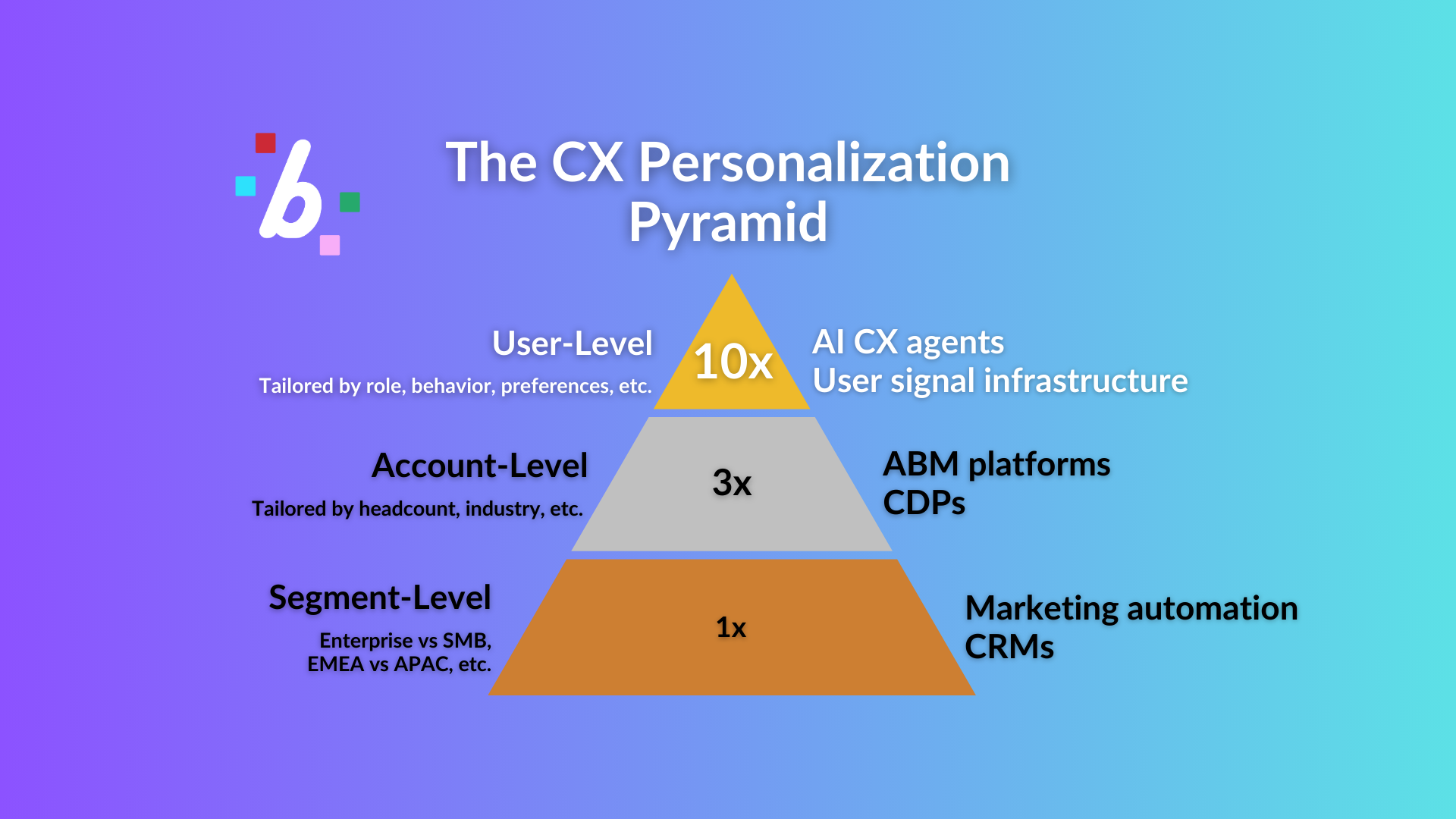
Level 1: Segment-level (enterprise vs SMB, EMEA vs APAC, etc.)
Level 2: Account-level (tailored by company)
Level 3: User-level (adapted to each unique user)
Most organizations get stuck between Level 2 and Level 3, and that’s because it’s a massive step-change in operational complexity. Consider what individual-level personalization actually requires:
- Understanding each user's communication preferences
- Tracking their specific product usage patterns
- Knowing their role, technical sophistication, and goals
- Adapting tone, depth, and format accordingly
- Maintaining this context across every touchpoint
With human-only operations, this doesn't scale beyond your highest-value accounts. The math simply doesn't work when you're managing hundreds of thousands of users.
But with agentic AI, we finally have a tool that can help overcome this hurdle.
Agentic AI Changes the Feasibility Equation ↩️
The breakthrough isn't just that AI can answer questions, but rather that AI can operationalize individual-level personalization at enterprise scale.
We're seeing organizations analyze millions of historical interactions to build user archetypes. Not broad personas, but specific behavioral profiles for each individual based on how they actually engage. Think:
- The "technical powerhouse" who wants to go deep on implementation details
- The "bright and brief" user who needs fast answers to keep moving
- The "empathetic listener" who needs context and reassurance before moving forward
What used to be theory is now in production today, serving tens of thousands of users. But training this system isn’t automatic, and many organizations lack the user signals that they really need.
Signal > Content 📡
Where most AI implementations go wrong is they focus exclusively on training their agents on organizational content:
- Product documentation
- Knowledge base articles
- Help center content
- Etc.
These are important, but insufficient. The organizations seeing success are building what we call "signal frameworks," aka rich contextual data that informs every interaction:
- Product signals: What features are they using? What haven't they adopted? Where are they getting stuck?
- Support signals: What cases do they have open? What patterns emerge from their history?
- Behavioral signals: How do they prefer to learn? What's their technical depth? What's their communication style?
- Business signals: What complexity are they managing? What other changes are happening at their organization? What does success look like for them?
The content tells the agent what answers exist. The signals tell it which answer to give, how to frame it, and what else might be relevant based on this specific user's context.
Digital Agents + Human Agents: A Partnership 👥
The most sophisticated implementations aren't replacing human agents, but instead creating a unified system where both digital and human agents operate from the same intelligence layer.
When a user interacts with a digital agent, all context flows into the case record. If they escalate to a human, that person sees everything, including what the user already tried, what the agent recommended, and the user's archetype and preferences. No repeating, no starting over.
The same personalized reports and user assessments that inform the AI also land in the CSM's dashboard before their next customer call. Both sides of the experience get smarter together.
Achieving this requires a specific organizational structure. In the most effective approach we've seen, business leaders own outcomes and performance metrics while technical partners manage vendor relationships and implementation details. This keeps roles clear and ensures that tool selection is always accountable to business requirements.
Going Slow to Go Fast 🐢
The hard reality is that organizations that rush to deploy AI chatbots without the supporting infrastructure end up disappointed. But those who invest time building their signal framework first see dramatically better adoption and outcomes.
Yes, it takes longer to instrument your product, clean your interaction data, and build user archetypes. But once that foundation exists, you can move fast. New use cases become straightforward to deploy. Performance improves continuously as you dial signals up or down based on what's working.
For the first time, individual-level personalization at enterprise scale is technologically feasible. The companies building toward this reality are methodically constructing the signal infrastructure that makes true personalization possible. Because in the end, the breakthrough isn't that AI can talk to your customers for you. It's that AI can finally know them well enough to make every interaction truly personal.
Did a friend forward you this article? Subscribe to Beyond The Click and get the latest on Pendo and Product Ops straight to your inbox every other Thursday.⚡