
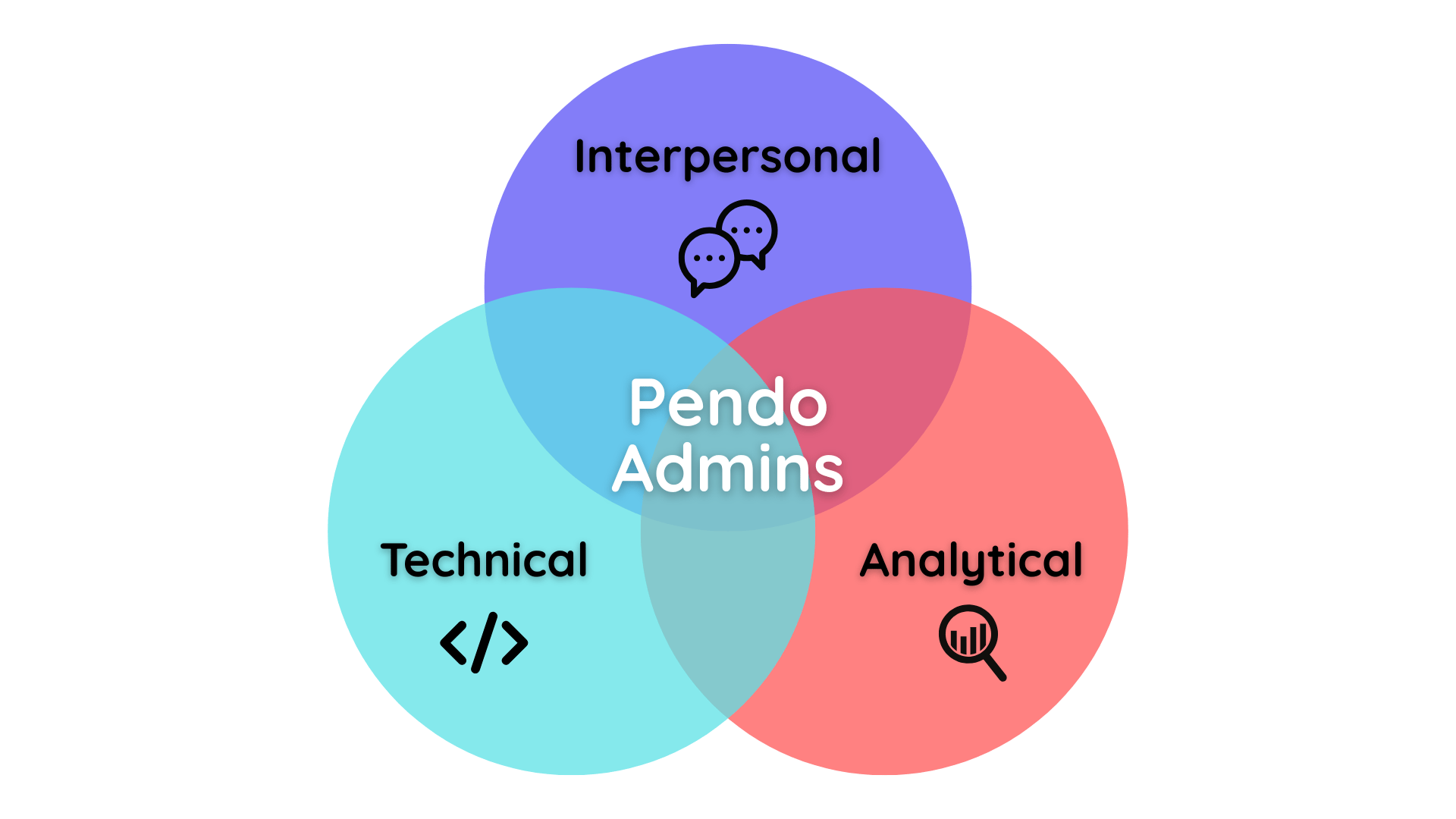

If you're using Pendo for your product analytics and in-app guides, you already know how powerful the platform can be with the right people running it. We've written before about how Pendo Admins will become to ProdOps what Salesforce Admins are to RevOps today. Just as RevOps teams discovered that a great Salesforce Admin can 10x the value of their Salesforce investment, product organizations are learning the same lesson with Pendo.
Welcome to Beyond The Click by Balboa Solutions. In today's issue we're breaking down the skills and experience that make for a great Pendo Admin:
- Pendo Admin table stakes
- Technical skills are the foundation
- Data analysis drives the business value
- Interpersonal skills are underrated
- When the role goes wrong
BTW, this material is inspired by how we do things at Balboa Solutions, and we're always looking for great Pendo Admins to work with. If that sounds like you, reach out to us 👉 info@balboa.solutions.
Let's dive in.
Pendo Admin table stakes 👑
At its core, the Pendo Admin role involves managing and maintaining your company's Pendo instance. The day-to-day responsibilities include:
🛁 Cleanup of tags, events, features, and pages
💪 Creating and testing guides with proper activation rules
📊 Building dashboards and running reports
🔎 Monitoring data to identify trends and opportunities
💼 Collaborating with the marketing, product, and customer success teams
If this list feels straightforward, don't be fooled: the baseline profile for this role is more senior than most companies realize. We're talking about someone with 2-4 years under their belt who has developed real business acumen. The ideal candidate has worked extensively with Pendo, possesses strong organizational skills, and feels comfortable operating with data.
But while these table stakes get you in the door, the real differentiators run deeper. 👇
Technical skills are the foundation 🏛️
You can find plenty of people who know how to use Pendo operationally. Creating guides, building basic dashboards, running reports, etc. are all learnable skills. And AI code creation tools can handle 60-70% of guide customization jobs, even for Admins without any programming background. But a key skill we always look for in a Pendo Admin is CSS selectors.
A strong understanding of CSS selectors, including ID recognition, parameters, contains rules, child rules, etc., is absolutely critical for effective tagging. And here's the kicker: there's no comprehensive training for this on the market. You learn it through years of experience, trial and error, and deep work in the Pendo platform. Even ChatGPT struggles to help with CSS selector challenges because the context is too specific and nuanced.
Why does knowing how to work such a specific feature matter so much? Because CSS expertise determines whether you can actually tag something or need to send it back to your dev team for code changes. Get this wrong and you'll waste developer time asking them to modify code that was already taggable. Get it right and you'll build trust as someone who knows the boundaries of what's possible.
This skill is often the difference between a Pendo Admin who enables their team and one who creates bottlenecks. Pair it with 1+ year of programming experience (necessary for checking code in advanced use cases, like injecting metadata into URLs) and your technical foundation is solid...but it's also just the beginning. 👇
Data analysis drives the business value 📊
The real value of a great Pendo Admin comes from their ability to find meaningful insights in the data. This is the hardest skill to teach.
Here's a common scenario: a stakeholder asks for feature clicks over the last three months. A mediocre admin might deliver just that, but a great admin will recognize that raw click counts might be meaningless to their stakeholder. If the feature gets 10,000 clicks, but it's on a page with a million visitors, it's actually performing terribly, indicating the feature may be "below the fold" - a discoverability issue. This insight wasn't something anyone asked for. It was discovered through critical thinking during routine analysis.
The best Pendo Admins constantly ask themselves: "Can I give them an action item?" Instead of just presenting data, they provide recommendations. They understand the difference between what stakeholders think they need and what will actually help them make better decisions. When someone requests basic page views, they provide comparative analysis and context. They explain why certain metrics matter more than others for specific use cases.
This analytical mindset transforms Pendo from a reporting tool into a strategic asset. Stakeholders start coming to you not just for data, but for interpretation, which is part of why Pendo Admin is actually a very interpersonal role. 👇
Interpersonal skills are underrated 👥
Here's what surprises most people about this role: you'll likely spend more time in meetings than you will tagging pages. The role often follows a 60/40 time breakdown, which flips based on your company's Pendo situation:
- New or messy instance: 60% technical work, 40% stakeholder interaction
- Established + mature instance: 40% technical work, 60% stakeholder interaction
Once your instance is running smoothly, you'll spend the majority of your time explaining decisions, conducting trainings, showing stakeholders how to use dashboards, and answering questions about implementations that were built perfectly fine, but people need to understand better.
This interpersonal heavy lifting requires skills you can't learn from documentation:
- Handling frustrated stakeholders tactfully while juggling requests from multiple teams
- Explaining technical decisions confidently to non-technical audiences
- Managing competing priorities across your colleagues in product, marketing, customer success, and engineering (without direct authority)
These soft skills are critical but take years to develop. A technically brilliant Pendo Admin who can't communicate effectively will create as many problems as they solve. Which is why ProdOps orgs need to watch out for this key mistake. 👇
When the role goes wrong 🚨
The Pendo Admin role falls apart when employers treat it as an entry-level position. We understand why organizations make this choice: they figure they can save money hiring someone fresh out of college to just learn Pendo and handle the tagging.
But here's what usually happens: that person struggles with the complexity of CSS selectors, lacks the business context to derive meaningful insights from data, and gets overwhelmed trying to manage stakeholders across multiple functions. The Pendo instance becomes poorly structured, tags proliferate without logic, and guides miss the mark. Eventually, the company realizes they need outside help to fix what's broken, and the cost savings evaporate.
This isn't the Admin's fault. They were set up to fail by being asked to do a mid-level job with entry-level experience. The role demands someone who can balance tedious technical work (because yes, the 30th page tag is still boring) with strategic thinking and confident stakeholder management. That combination simply requires maturity.
Moving Forward 🛣️
If you're a product ops professional eyeing a Pendo Admin role 👨💻
Focus on building your CSS selector expertise through hands-on Pendo work. Practice analyzing data for insights rather than just generating reports. Look for opportunities to manage cross-functional stakeholders and develop your communication skills. This role sits squarely in the product operations career path and offers excellent exposure to how product decisions get made.
If you're a business leader trying to hire for this position 👨💼
Resist the temptation to staff it at the entry level. Budget for mid-level compensation and look for candidates with 2-4 years of relevant experience. In your interviews, ask candidates to describe a time they discovered meaningful insights while working with data. Their answer will help you determine whether they can truly add value or just run reports.
Did a friend forward you this article? Subscribe to Beyond The Click and get the latest on Pendo and Product Ops straight to your inbox every other Thursday.⚡