

Coordinating in-app content at enterprise scale is tricky. It's an intersection of Product, Customer Experience, and other teams that often feels like an overlap of roles and responsibilities. Fortunately, digital experience governance is a great answer to this problem.
Welcome to Beyond The Click by Balboa Solutions. Today we're sharing our RACI matrix (download it here🔗) for managing in-app content and unpacking how/why to use it, including:
- Why in-app content needs DX governance 🖥️
- Why current processes fall short 🛠️
- Why great processes succeed 📈
- How to build a great process with a RACI matrix 🏆
Let's dive in.
DX governance is critical for in-app content 🖥️
We recently encountered a cautionary tale that perfectly illustrates why governance matters. A product team, taking ownership of everything displayed within their application, built a custom in-app guide from scratch. It looked nearly identical to a Pendo guide, and they deployed it without coordinating with anyone.
The problem? The CX Ops team was already running Pendo guides on the same page.
The result was a cluttered, confusing experience that made the product experience worse, not better. Both teams had good intentions, but without clear governance, they ended up working against each other.
This story isn't unique. As in-app content becomes a primary channel for customer communication, the question of ownership becomes critical. Unlike email or traditional marketing channels, in-app content sits at the intersection of product experience, customer experience, and customer marketing.
If prioritization and governance aren’t aligned across teams, you risk not just internal inefficiency but also damaging the digital experience. Get it right, and you unlock a powerful tool for increasing user engagement, driving adoption, mitigating risk, and scaling your customer experience.
The default model: product owns the experience 🛠️
In the most common approach we see, the Product organization owns the in-app experience and decides:
- What Guides appear
- Where they show up
- What the messaging strategy is
- When users see them
After all, they own the product experience, so why shouldn't they own everything displayed within it?
This model is straightforward and can work for small companies where product teams have a deep connection to customer needs and the necessary context on messaging strategy. It keeps decision-making simple and avoids the need to establish cross-functional processes.
However, the limitations become clear with scale:
- Product teams aren't accountable for content strategy. They're built for feature development and UI management, not crafting relevant messaging across your various customer segments and personas.
- They don’t have insight into nuanced customer segmentation. GTM teams that manage the customer relationship own the variations in engagement strategies across cohorts of accounts. They decide which customer accounts should fall in a heavily digital motion (where in-app content should be prioritized) as well as which accounts should be treated in a hybrid high-touch + digital manner.
The maturity model: "How/Where/When" vs "What/Why" 📈
A sophisticated approach splits responsibilities based on expertise:
Product owns the technical guardrails (the “How/Where/When”):
- Where content can appear
- Placement specifications and page locations
- Throttling rules (message volume and frequency)
- Publishing and deployment
CX and Marketing own the content strategy (the “What/Why”):
- What gets communicated
- Why it matters to specific segments
- Which customer segments receive which messages
- Content development and iteration
In-app content can and should be treated as one of multiple channels you are using to engage your customers across the lifecycle. Having teams manage what content is triggered, at what stage of the journey, and in alignment with other comms is key to building a governed program. Managing ongoing content iteration and optimization across channels is a dedicated focus that usually resides in a content strategy team that has a view of strategies across the customer lifecycle.
But even though customer-facing teams develop the content, a good governance process will route back through Product for final review and publication. This ensures technical alignment and prevents conflicts.
The advantages of this model are substantial. It leverages specialized expertise where it matters most, allowing Product to focus on product development rather than message management, while also giving them final approval authority and enabling the sophisticated segmentation that modern customer bases require.
But as effective as this model is, it falls apart without a plan for execution. Which is why we built our RACI matrix to manage the roles and responsibilities within an in-app content program.
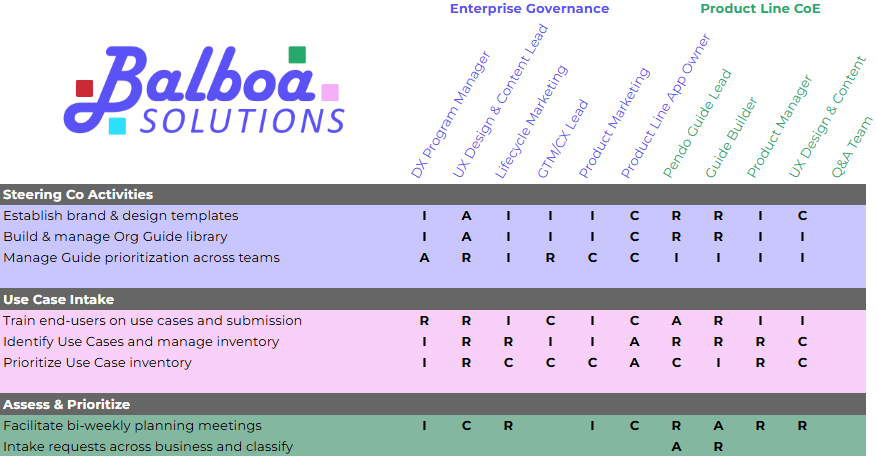 Link: In-App Content Governance RACI 🔗
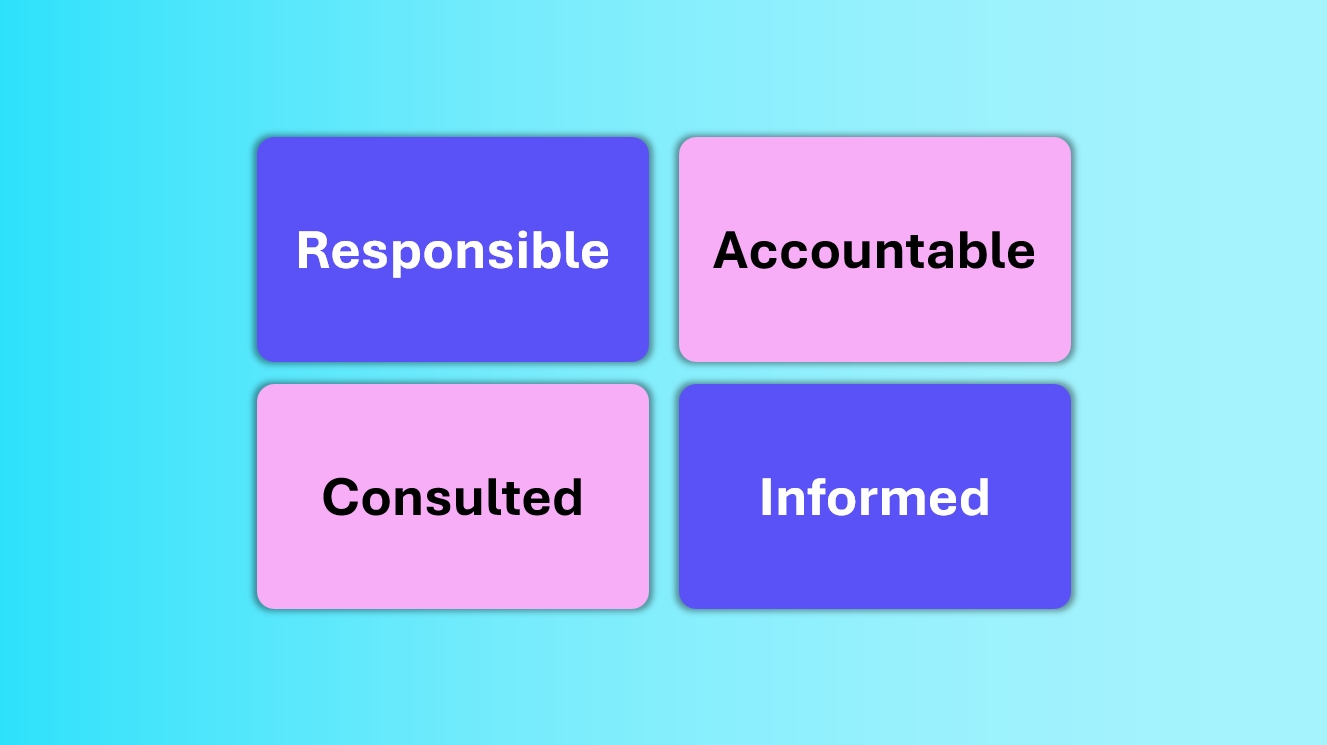
Here we outline the 26 steps of a strong content governance model with accountable ownership identified across role types using the RACI method:
- Responsible: The “doer” of the item. This role is a part of execution.
- Accountable: The “owner” of the item. Signs off on strategy and owns the goal.
- Consulted: The "advisor” of the item. Advises on context in critical ways.
- Informed: The “beneficiary” of the item. Not directly involved, but will benefit.
This matrix is a comprehensive tool, but pay special attention to three critical personas:
The DX Program Manager
This role sits across the org, spanning multiple product lines and business units, and manages the digital experience program across teams. In organizations with dozens or hundreds of applications, someone needs to own planning, priorities, and standards at the enterprise level. Without this role, you risk fragmentation across the digital experience.
The UX Design & Content Lead
Ideally a Director or VP-level leader, they provide oversight for the in-app content program and own the org-level guide library. When app-specific teams can leverage pre-built, brand-compliant guides instead of building from scratch, someone needs to govern that library and maintain design standards across all your applications. They also ensure UX content standards are met within the guides.
The Lifecycle Marketing Lead
Product marketing focuses on bringing features to market, but lifecycle marketing (or customer marketing) are experts in the customer, creating relevant messaging to drive engagement throughout the journey. By including customer marketing expertise in your DX program, you can leverage value-oriented messaging to increase engagement in-app.
Putting it into practice 🏆
The governance challenge is more organizational, less technical. When you get the right people in the right roles with clear accountability, in-app content becomes a strategic lever. The maturity model we've outlined here requires coordination, but the payoff is substantial: better customer experiences, higher engagement rates, and a scalable program that spans your organization. Download the full RACI matrix and start building the governance model your DX program needs.
Did a friend forward you this article? Subscribe to Beyond The Click and get the latest on Pendo and Product Ops straight to your inbox every other Thursday.⚡