


The customer experience landscape is shifting under our feet. While most product teams are still thinking about digital CX as something that happens downstream from the product, the smartest organizations are realizing a fundamental truth: your product IS the customer experience.
Welcome to Beyond The Click by Balboa Solutions. In today's issue we're giving you a practical guide to implementing our DCX Accelerator framework for your business. It's based on a practical workshop we recently led with an enterprise HR product company, and it includes:
- Why: Your product IS the CX
- What: DCX Accelerator intro
- How: The process
- Where: Focus areas
- Who: Staffing + governance
Let's dive in.
Your Product IS the Customer Experience 🔥
Here's where most product teams get it wrong: they think customer experience is what happens in Salesforce, in support tickets, or in quarterly business reviews.
But your customers spend most of their time in your actual product. In fact, every interaction with your product is a CX moment:
- Go-live: Foundational training, engagement metrics, login activity
- Adoption: Continuing education, feature adoption, calendar-driven nurtures
- Value: Role-based enablement, account retention, surveys and action
- Renewal: Engagement scoring, behavioral risk monitoring
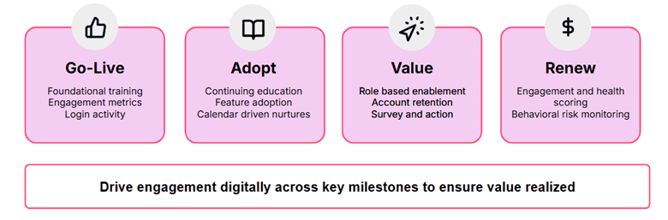
The objective here is identifying where digital engagement can augment your existing CX initiatives. You want to reach customers right within their product journey, driving engagement across key milestones to ensure value realization. And the ultimate impact of this is step change in your retention rates.
Agree with this in principle, but not sure how to put it in practice? That's why we developed the DCX Accelerator. 👇
Introducing DCX Accelerator 🏃
The Digital Customer Experience (DCX) Accelerator isn't another workshop format - it's a systematic approach to aligning your organization around in-product customer outcomes.
The real power of it comes when you pull together a cross-functional team that actually owns different pieces of the customer journey:
- Customer success teams who see renewal risk daily
- Pre-sales engineers who understand initial value realization
- Support teams who handle friction points in the product
- Account managers who own expansion conversations
These stakeholders bring energy to the process because they desperately need better product telemetry data and in-app capabilities to scale their impact. They're fighting fires with incomplete info, and a DCX Accelerator gives them the tools to be proactive instead of reactive.
The visual below gives a sense for how many functions in your business impact the customer experience - and it all centers on the product.
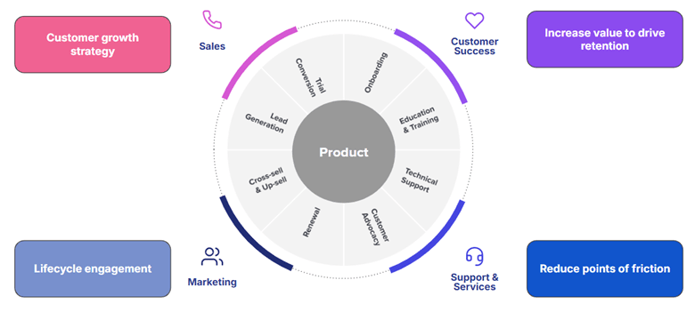
It feels like a lot to handle, but we built the DCX Accelerator as a process to make some sense of it. 👇
The DCX Accelerator process 📋
The framework is simple, but it takes disciplined execution in four steps:
1. Problems to Solve 🔍
- Document known friction points impacting in-app engagement
- Identify where users struggle and hit blockers in their journey
- Surface internal gaps and challenges affecting your team's effectiveness
2. Target Audience 🍿
- Define roles clearly (Admin vs User vs Decision-Maker)
- Establish concrete attributes for segmentation (job title, SFDC fields, behavioral data, etc.)
3. Digital Engagement Strategy 🖥️
- Audit current nurture channels (email, webinars, support, etc.)
- Map tactics to specific journey stages
- Identify gaps between current and optimal channel strategy
4. Performance Metrics 📊
- Establish key engagement metrics for your teams to use
- Quantify gaps between expectation and reality (pre-renewal engagement, feature adoption rates, etc.)
This process creates alignment between what you're building and what actually drives customer success. And it applies to all areas of your DCX. 👇
Focus areas for the DCX Accelerator 🔬
To narrow the focus, we recommend applying the 4 steps above to specific focus areas in your customer experience. Your mileage may vary, but we recommend starting with these:
Moments That Matter ⌛
Business events customers face annually - open enrollment periods, year-end processes, performance review cycles. These date-driven milestones create predictable in-app behavior patterns you can optimize around.
New Product & Feature Adoption ✨
Systematic opportunities to drive adoption of new capabilities through in-product experiences rather than external communication.
Current Product Optimization 🔧
Enhancing engagement within existing product areas and driving adoption of newly released features where users already have established workflows.
Risk Mitigation 🚑
Key friction points across the customer lifecycle that limit product adoption and create renewal risk.
Each focus area gets the full four-step treatment, creating a comprehensive playbook for digital customer experience. Now, we just have to get the right cross-functional team to actionize it. 👇
Good governance: staffing the DCX Accelerator 👩💻
Success here requires the right team structure with clear accountability. Based on your needs, these roles might be one or multiple people, internal or external*:
The Steering Team 🚢
-
Executive Sponsors*: align with org strategy and secure resources
- Engagement Lead*: provides program leadership and coordinates workstreams
The Core Team 💪
- DX Strategist (aka "The Voice of the Customer")*: facilitates workshops and advises on enterprise strategy
- Technical Consultant: configures use cases and integration architecture
- Pendo Admin*: manages day-to-day implementation and best practices for the product analytics platform
The Extended Team 🏢
- Business owners & process experts*: who understand what your business needs at an organizational level
- Product and data experts*: who understand your product's technical capabilities
* = needs at least one internal person to be successful
The key is balancing internal expertise with external perspective, ensuring you have both strategic vision and tactical execution capabilities.
Pedal to the metal 🚘
The DCX Accelerator approach works because it treats your product as the primary customer experience channel it actually is. Instead of thinking about customer success as something that happens around your product, you're designing success directly into the product experience itself.
This shift requires organizational alignment, systematic process, and disciplined measurement. But for product organizations willing to make this transition, it's the difference between hoping customers succeed and designing their success into every interaction.
The question isn't whether your product impacts customer experience. The question is whether you're being intentional about how.
Did a friend forward you this article? Subscribe to Beyond The Click and get the latest on Pendo and Product Ops straight to your inbox every other Thursday.⚡